|
Memory Pages
General Notices
Big Four Depot
Railroad Stations
Breakup Of
Conrail
Selected Slides
Memory Pages
Big Four (NYC)
'Bee Line'
Michigan Div.
NYC Power
PCC&StL (PRR)
Columbus Div.
Delco Tower
DOW Tower
Elwood
EA&L RR
Indian Creek
The Circus
Circus Trains
RB&BB Train
CI Rwy & CIW
Nickel Plate
Traction (IRR)
Bibliography
Maps
Indiana Sites
Contact the
Webmaster:
Roger Hensley
Page Updated
04/28/2018
|
Railroads of Madison County
Maurice Lewman
Memories
|
Michigan Division
Alexandria Revisited and Fast Work
April 17, 2001
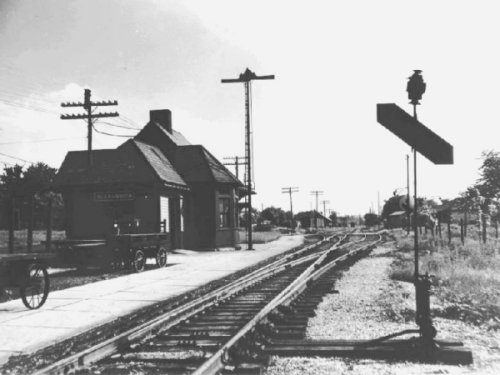
When I saw Mr. Kneeling's story of the Alex depot it brought back some memories. By the time I hired out as a fireman in 1950 all of the business referred to in his article was gone and the passenger train had been gone 2 years. The track was still 40 mph and Alex was still a one trick block office.
I described in another article how stopping at the NKP interlocking at Alex northbound was a sweaty palms stop. The stop at the interlocking southbound was easier but you still had to keep on your toes to make a power brake stop within 40 ft of the signal. On the Michigan Division they had a semaphore signal that was in a fixed approach position called approach restricting. Most of these signals were about 70 cars from the interlocking and made good distance markers for the engineer.
We are on # 75 with engine 3035 an L3 with 69 cars and about 3500 tons. The approach restricting signal was about 3 blocks north of the depot. The engineer has the throttle about half open running 40 mph. As he passes the approach restricting he makes a 7 lb. reduction of the air. As we go by the depot at about 35 mph the engineer is watching speed and distance. Due to a flat place in the grade from highway 28 to the approach restricting the train starts slowing down from 35 mph rapidly. By a slight adjustment of the throttle and the train starts setting down. A final reduction of the air and at the proper time the throttle is closed and the train stops within 40ft of the signal. After the diesels came and the trains became longer and the tonnage grew you had to adjust your braking method to suit. In fact I started setting the brakes where highway 9 crosses the railroad at the north edge of Alex in order to keep the train stretched out for better control of the train. Train line leakgage and tonnage play a big part of how, when and where. Firing for Bill Sailors, we had 135 cars with about 45 empty hoppers on the head end. The train line leakage was terrible. Bill coming at 40mph by the depot lapped the brake valve and with the leakage it was just like making a full brake reduction instantly and the engine stopped about 60 ft. from the signal.
After the 26 automatic brake valve with the pressure maintaining feature and the improved AB control valve on the cars, train line leakage became less of a problem. This was just a stop at one location. On the Michigan we made 8-10 stops like this every trip north or south between South Anderson and Elkhart. An engineer must be able to take these variables and make them appear as not variables, but as the same stop at all places.
Maurice Lewman
Fast Work
(the rest of the story)
April 18, 2001
The NYC left about 15 car lengths of track on the south end of Alda siding south of Alex. The north bound local set a south bound pick up in the Alda stub track. We are on # 75 and have to pick up ten cars at Alda. As we are approaching the road crossing, Sailors, to stir up the brakeman, said, I don't think you can make the pick up in the time the fuzee (5 min.) is thrown on the road crossing and burns out. The fuzee lands burning on the crossing, we pull down, cut the engine off, pull by the switch, make the pick up and pull out, couple onto the train and make the air coupling. While the brakeman is walking to the engine, checking the hand brakes the air brakes release, Sailors has the train moving and the brakeman on board. The fuzee is flickering out and the train is moving. Today with the operational changes this move would take at least 15 min. I still think it would have to be classed as fast work.
M.E.L
Two of us were coming south with 125-130 cars in each train. I was behind and we both had a meet with the local at Alex. Now in the photo you are looking south. The local filled up the left track and came out with the left over cars that would not fit in the east or left track and put them in the west track including the power. They backed in and the brakeman lined the switch for the main on the west track and they told the first train to come on down they were in the clear. Well someone forgot the east switch and the first train headed in on the cut ,but they saw that the track was not lined for the main and almost got stopped. The crew contacted us and told us not to come down that they had a problem . The other train did hit the other cut but there was not any damage. They backed out and went on their way . They let us down after the other train had been gone 10 min. and to take it easy but everything was ok. This shows that you must always be checking yourself and these were good men. Today with just 2 men it is a full time job. One of the crew and I forget which train, said we sure was glad you were not on the first train. I never asked why.
LEW
Maurice worked the Michigan Division from 1947-1981. He then worked on the Bee Line from 1981-1992. From
1947 until august 1950, he worked on the section at Shirley and Markleville. In 1950 he started firing on steam and then on through the diesels. Maurice said, "I had the pleasure of working with C. C. Staley and Ron Buser many times."
|
|